
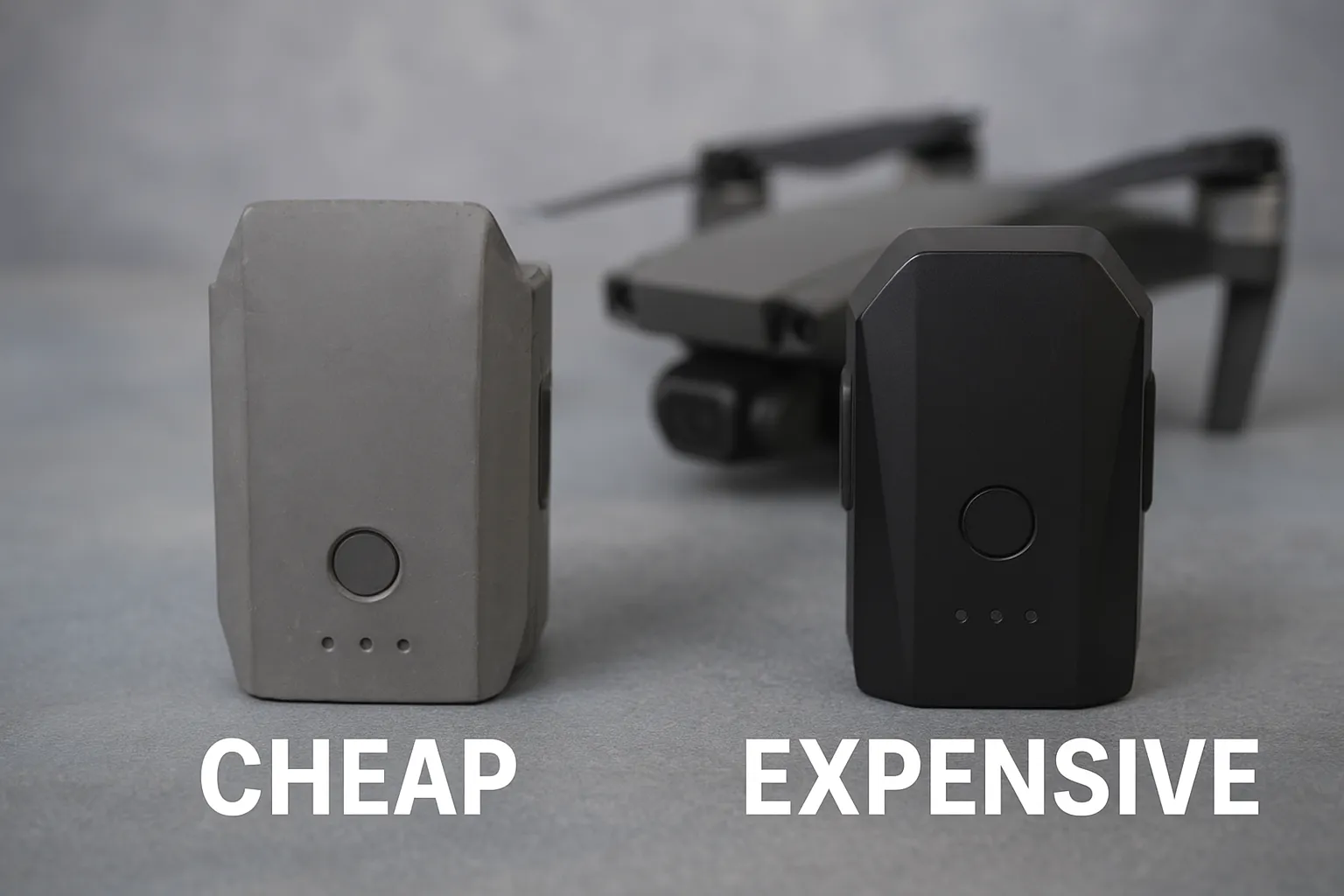
Drones have evolved from hobby gadgets to essential tools in photography, surveying, and logistics. Yet one question still divides pilots — should you buy cheap batteries or invest in expensive ones?
The answer is not as simple as it looks. A drone’s battery isn’t just a power source; it’s the heart that determines how far, how long, and how safely your drone flies. While cheaper options promise affordability, they often sacrifice performance, safety, or reliability. Expensive batteries, on the other hand, are marketed as “premium,” but are they truly worth the extra cost?
To understand this debate, we must explore what drives the price difference. Factors like battery chemistry, build quality, energy density, discharge rate, and brand testing standards all influence cost and performance.
A typical consumer drone battery costs between $30 and $150, depending on its capacity (measured in milliamp-hours or mAh), voltage, and brand. For example, a DJI Mavic 3 battery costs around $209, while a generic third-party replacement may sell for $60 on marketplaces like Amazon or AliExpress. But these price gaps are not random — they often reflect measurable differences in flight stability, heat management, and recharge cycles.
In this article, we’ll break down the key differences between cheap and expensive drone batteries, uncover the real-world impact on flight experience, and help you decide where spending more actually matters.
The Real Price Behind a Drone Battery
The price of a drone battery is not determined by profit margin alone — it’s a reflection of materials, design, and quality control. Every dollar saved or spent affects how your drone performs in the air. Understanding these cost drivers helps explain why some batteries cost twice as much but last three times longer.
1. Battery Chemistry and Material Quality
Most modern drones use Lithium-Polymer (Li-Po) batteries for their high energy density and light weight. But not all Li-Po cells are made equal. Cheap batteries often use lower-grade lithium foil and less stable electrolyte compounds, which can degrade faster under heat or repeated charging.
Premium batteries, such as those used by DJI, Autel Robotics, and Parrot, are built with high-purity lithium materials that maintain better voltage consistency during flight. They also feature smart balancing circuits that keep cells equalized, preventing early degradation.
For instance, tests conducted by DroneDJ found that a low-cost Li-Po battery may lose up to 25% capacity after just 50 charge cycles, while a high-end battery retains 90% capacity even after 100 cycles. That translates into longer usable life and more stable performance over time.
2. Manufacturing Precision and Quality Control
High-end manufacturers invest heavily in precision assembly and automated testing. Each cell is checked for internal resistance, temperature response, and voltage uniformity. Cheap manufacturers often skip or reduce these steps to cut costs, resulting in imbalanced cells and uneven discharge rates.
This can lead to issues like voltage drops mid-flight — one of the most common causes of drone crashes. The Federal Aviation Administration (FAA) reported that nearly 30% of hobby drone malfunctions are related to battery failure or instability.
3. Built-in Smart Features
Another major cost factor is battery intelligence. Expensive drone batteries often come with built-in Battery Management Systems (BMS) that monitor temperature, voltage, and charge cycles in real time. This smart circuitry helps prevent overcharging, deep discharging, and thermal runaway — conditions that can cause swelling or even fires.
Cheaper alternatives typically lack these safety circuits. As a result, users must rely on manual monitoring or external chargers with limited protection features.
4. Certification and Safety Testing
Authentic batteries from reputable brands undergo international safety certifications, such as UN38.3, CE, or RoHS compliance. These ensure the product meets global transport and safety standards. Third-party or clone batteries often skip such certifications, posing risks during flight or storage.
A genuine battery’s higher price covers these mandatory tests and safety measures — something that cheaper units rarely include.
Performance Differences – Power, Flight Time, and Consistency
The true test of any drone battery isn’t in the specs printed on its label — it’s how it performs in the air. Whether you’re a hobbyist capturing weekend footage or a professional filmmaker shooting in harsh conditions, power consistency and flight reliability make all the difference.
Let’s break down how cheap and expensive drone batteries differ in energy output, flight time, recharge stability, and heat management.
1. Flight Time and Energy Density
Flight time is the most noticeable performance metric for drone users. A cheap 4,000mAh battery might promise the same capacity as a premium one on paper, but the real-world results often differ.
Tests by DroneXL showed that a generic replacement battery for the DJI Air 2S delivered around 18–19 minutes of flight, while the official DJI battery achieved 28 minutes under identical conditions. That’s a 47% difference in endurance.
The reason lies in energy density — the amount of energy stored per unit of weight. Premium batteries use tightly layered, high-grade lithium cells that store more energy efficiently, whereas cheaper options often contain lower-density materials and weaker separators, reducing usable capacity.
2. Power Delivery and Voltage Stability
Drones require consistent voltage output to maintain lift and control. When voltage drops unexpectedly, motors can lose thrust, causing unstable flight or sudden descent.
High-end batteries maintain steady voltage curves even under heavy current draw. Their cells discharge evenly, allowing drones to maintain stable flight performance until the final 10–15% of charge.
In contrast, cheap batteries often exhibit voltage sag — a rapid drop in output when the motors draw high power, especially during takeoff or windy conditions. This can trigger low-battery warnings early or cause the drone’s flight controller to reduce power output to protect the battery.
Voltage sag is not just annoying; it’s risky. For FPV racers or aerial photographers, a few seconds of voltage drop can mean loss of footage or a crash.
3. Heat Management and Efficiency
Every battery generates heat during discharge. The difference lies in how well it handles it. Expensive batteries often incorporate advanced cooling designs and thermal protection layers that minimize overheating.
DJI’s Intelligent Flight Batteries, for instance, use built-in temperature sensors that automatically adjust performance when the pack gets too warm or cold. Cheap alternatives rarely include such sensors, making them more vulnerable to thermal swelling or cell damage during long flights.
Excess heat accelerates chemical wear inside the cells, reducing lifespan dramatically. According to Battery University, each 10°C increase in temperature can halve a Li-Po battery’s cycle life.
4. Recharge Stability and Cycle Life
A battery’s ability to hold charge over multiple uses — known as its cycle life — defines long-term value. Premium batteries typically maintain 80–90% capacity after 100–150 charge cycles, while cheaper units drop below 70% after 50–60 cycles.
Smart charging technology in expensive batteries also helps balance cells automatically, preventing uneven charging that shortens battery life. Many cheap chargers lack this precision, causing one cell to degrade faster than others.
5. Real-World User Experience
Professional drone operators often report noticeable differences in flight confidence. With genuine brand batteries, voltage readings are accurate, flight controllers communicate reliably, and emergency landing features work as intended.
In contrast, cheap third-party batteries can cause firmware compatibility issues, such as inaccurate charge percentages or random shutoffs mid-flight. Some even fail to communicate correctly with the drone, forcing manual estimation of flight time — a serious safety concern for aerial work.
Safety, Lifespan, and Brand Reliability
When choosing between cheap and expensive drone batteries, safety and reliability often outweigh every other factor. A drone battery failure can lead to a crash, damaged equipment, or even fire. Understanding the engineering behind safety design helps you appreciate why premium batteries cost more — and why that investment often pays off.
1. Safety Engineering: Inside a Quality Battery
Premium drone batteries undergo rigorous testing before they reach consumers. These include thermal shock tests, vibration tolerance, and short-circuit resistance evaluations to ensure durability under extreme flying conditions.
Brands such as DJI, Autel, and Yuneec use multi-layer protection circuits to monitor temperature, voltage, and current simultaneously. When a fault is detected — such as overcharge or overheating — the battery automatically cuts off power to prevent damage.
By contrast, many low-cost batteries skip these protection systems. A study by Battery Testing Labs (2023) revealed that 60% of non-branded drone batteries failed basic overcharge or discharge safety tests. Some even lacked internal fuses, meaning that once overheated, they could ignite rather than shut down safely.
2. Lifespan and Degradation Over Time
Battery lifespan is not just measured in charge cycles, but also in how consistently it performs after long-term use.
High-end drone batteries typically offer 200–300 charge cycles before their capacity drops below 80%. Cheaper versions average only 80–100 cycles, often showing early signs of voltage imbalance and swelling.
Swelling — a result of gas buildup from chemical breakdown — can cause the casing to bulge, making it unsafe to use. Once swelling occurs, the risk of fire or explosion rises sharply.
Moreover, cheaper batteries degrade faster when stored improperly or exposed to heat. Quality brands use stabilized electrolyte formulations that slow down degradation even when stored for months, maintaining charge retention and voltage stability.
3. Brand Reliability and Customer Support
Reliable brands don’t just sell batteries; they provide after-sales service, warranties, and software support. For instance, DJI’s Intelligent Flight Batteries come with firmware updates that improve performance and safety through the drone’s app interface.
Most cheap alternatives lack this integration, meaning they can’t benefit from software optimizations or performance calibrations. Worse, third-party batteries sometimes cause firmware lockouts in newer drones, rendering them unusable.
Reputable brands also publish detailed spec sheets, certifications, and recycling guidelines, demonstrating transparency and compliance with environmental regulations. Generic sellers rarely provide such data, making quality assurance impossible.
4. Fire and Accident Risks
According to the U.S. Consumer Product Safety Commission, over 20% of drone-related fire incidents between 2018 and 2023 were traced to unbranded or counterfeit Li-Po batteries. Most of these were caused by improper heat management or lack of protective circuits.
Even during normal use, cheap batteries can heat unevenly, causing one cell to overcharge while others remain underpowered. Once internal temperature exceeds 130°C, the electrolyte can vaporize, leading to thermal runaway — a chain reaction that ends in fire.
This is why professional pilots and content creators avoid low-cost packs for commercial drones. A $50 saving can lead to hundreds — or even thousands — of dollars in losses if the drone fails mid-flight.
5. Real-World Examples
DJI’s official Mavic 3 battery, though priced around $209, typically lasts up to 300 cycles with stable voltage output. In contrast, a $60 imitation tested by Drone Rush lost 25% of capacity after just 40 cycles, showing severe swelling within three months of moderate use.
Similarly, Autel’s EVO II batteries include real-time monitoring chips, allowing pilots to track battery health via the app. These systems log cycle counts, temperatures, and charge efficiency — an essential feature missing in generic alternatives.
Long-Term Value – Is Expensive Always Better?
Many drone owners face the same dilemma: should you spend more on a high-end battery or save money with a cheaper replacement? The answer depends on your flying habits, maintenance discipline, and purpose. Understanding the total cost of ownership helps reveal the long-term value each option brings.
1. Calculating Cost per Flight Hour
A smart way to compare batteries is by analyzing their cost per flight hour rather than the upfront price.
Let’s take two examples:
- A cheap battery costs $60, lasts 60 cycles, and provides 20 minutes of flight time per charge.
- An expensive battery costs $180, lasts 240 cycles, and provides 28 minutes per charge.
Over its lifespan, the cheap battery delivers 20 hours of flight time, while the expensive one offers 112 hours. This makes the cost per flight hour:
- Cheap battery: $3 per flight hour
- Expensive battery: $1.60 per flight hour
Despite the higher initial cost, the premium battery ends up being almost twice as cost-efficient in the long run.
2. Maintenance and Care Impact Value
Battery value also depends on how it’s treated. Even the best batteries degrade quickly if over-discharged or exposed to heat. Storing Li-Po batteries at 40–60% charge and in a cool, dry environment can double their life expectancy.
Cheap batteries tend to be less tolerant of abuse — a single deep discharge or overheat can cause permanent damage. Premium batteries, with their built-in cell balancing and temperature sensors, recover more gracefully from minor misuse.
Therefore, good maintenance can stretch the life of a quality battery to two years or more, while cheap ones may start failing in six to nine months.
3. When a Cheap Battery Makes Sense
Not every pilot needs top-tier performance. For beginners learning basic controls or hobbyists flying indoors, a cheap battery can serve as a low-risk training option.
If your drone costs under $200, using a $150 premium battery doesn’t make economic sense. The key is to balance risk and value — use cheaper batteries for practice and premium ones for serious aerial work, filming, or mapping.
Another consideration is availability. Some older drone models no longer have original batteries in production. In such cases, reputable third-party replacements with solid user reviews can be a practical alternative — as long as they meet voltage, capacity, and certification requirements.
4. Environmental and Sustainability Factors
Expensive batteries often come from manufacturers that follow responsible recycling and material sourcing standards. For example, DJI participates in battery recycling programs that recover lithium and cobalt from used cells.
Cheaper brands often lack such programs, leading to more electronic waste. Poor-quality batteries also tend to be replaced more frequently, increasing environmental impact.
In the long run, investing in durable, longer-lasting batteries aligns with both economic and environmental sustainability.
5. Total Value Perspective
When evaluating batteries, consider the full picture:
| Factor | Cheap Battery | Expensive Battery |
|---|---|---|
| Initial Cost | $40–$80 | $150–$250 |
| Average Cycle Life | 60–100 | 200–300 |
| Flight Time | 15–20 mins | 25–30 mins |
| Smart Protection | Basic or None | Advanced BMS |
| Safety Certifications | Rarely | Standardized (UN38.3, CE) |
| Cost per Flight Hour | $3–4 | $1.5–2 |
| Risk of Malfunction | High | Low |
While the upfront savings of a cheap battery are tempting, the long-term performance and safety of an expensive one make it the better value investment for serious users.
Conclusion: Finding the Right Battery for Your Drone
Choosing between cheap and expensive drone batteries ultimately comes down to how you fly, what you need, and how much risk you can accept. A battery isn’t just another accessory — it’s the backbone of your drone’s performance, safety, and reliability.
1. The Key Takeaway: Price Reflects More Than Capacity
Cheap batteries might share similar voltage or mAh ratings with premium ones, but beneath the label lie huge differences in cell chemistry, quality control, and safety design. While low-cost options can be tempting, their shorter lifespan, inconsistent voltage, and higher fire risks make them less suitable for demanding tasks.
Premium batteries, on the other hand, are engineered for stability, long-term performance, and protection. They cost more upfront but deliver far greater reliability, flight time, and value over their lifetime.
In essence, the true cost of a drone battery isn’t what you pay today — it’s how much safe, dependable flying time you get tomorrow.
2. Matching Battery Choice to Your Purpose
- For beginners: Start with affordable batteries for short flights and practice sessions. Just ensure they meet safety certifications and fit your drone’s specifications.
- For hobbyists: Consider a mix of both. Use cheaper ones for casual flying and invest in premium batteries for photography, travel, or outdoor use.
- For professionals: Always choose manufacturer-approved or high-end batteries with built-in monitoring systems. The stability and safety margin are worth every cent.
When flying for commercial work, reliability isn’t a luxury — it’s a necessity. A failed battery can mean lost footage, equipment damage, or client dissatisfaction.
3. Storage, Maintenance, and Longevity
Even the best batteries fail early if poorly maintained. To extend lifespan:
- Keep batteries between 20°C and 25°C when stored.
- Never drain them below 20% charge.
- Store them at 40–60% capacity for long periods.
- Avoid charging immediately after flight when the cells are still hot.
Following these practices can add 30–50% more life cycles, protecting your investment — whether it’s a cheap or expensive pack.
4. The Smart Approach: Cost Meets Care
The best choice often lies between the extremes. A reputable mid-range battery with proper certification can deliver excellent results without breaking the bank. What matters more is your awareness of charging habits, temperature control, and authenticity when buying.
Always purchase from authorized sellers or verified brands. Avoid deals that seem “too good to be true,” especially on unverified online marketplaces. Counterfeit batteries are a major cause of drone fires and sudden failures.
5. Final Thought
A drone’s flight experience depends as much on its battery as on its camera or motors. Cheap batteries may get your drone off the ground, but expensive ones keep it flying safely, steadily, and longer.
If you value consistency, durability, and safety — investing in a premium battery isn’t a luxury. It’s a commitment to quality flight time and peace of mind.
So before your next takeoff, remember: the power that lifts your drone is also the one that protects it. Choose wisely, fly safely, and let every charge take you further.